

The Hidden Drag on Your Retirement Portfolio


Your stocks may not be the problem.
It could be the part of your portfolio you thought was keeping you safe.
For decades, one of the most common approaches to retirement investing has been some version of the traditional diversified portfolio: own stocks for growth and bonds for stability.
The classic example is the 60/40 portfolio—60% stocks and 40% bonds.
The logic is simple. When stocks are doing well, they drive the portfolio higher. When stocks struggle, bonds are supposed to provide stability and potentially offset some of the losses.
But something unusual has happened over the last five years.
Stocks have performed very well. Bonds have barely moved.
And if you've owned a substantial bond allocation, that "safe" portion of your retirement account may have quietly been holding back your overall returns.
Look at the Numbers
Let's use two widely followed benchmarks.
As of July 31, 2026, the S&P 500 Total Return Index had produced an annualized return of approximately 12.9% over the previous five years.
That means $100,000 growing at 12.9% annually would have grown to approximately:
$183,400
That's an increase of roughly 83%.
Now let's look at bonds.
The iShares Core U.S. Aggregate Bond ETF (AGG), which tracks the Bloomberg U.S. Aggregate Bond Index and is a reasonable proxy for the broad investment-grade U.S. bond market, reported a five-year annualized benchmark return of approximately 0.08% through June 30, 2026.
You read that correctly.
Approximately 0.08% per year.
At roughly that rate, $100,000 would have grown to only about:
$100,400
over five years.
That's an extraordinary difference.
The Problem Isn't That Bonds Didn't Beat Stocks
They weren't supposed to.
The purpose of bonds in a retirement portfolio has traditionally been different. They're generally there to reduce volatility, generate income and provide diversification.
The problem is what investors received in exchange for accepting those lower expected returns.
Over this particular five-year period, broad bonds delivered virtually no cumulative growth.
And bonds weren't without risk along the way, either.
The Bloomberg U.S. Aggregate Bond Index suffered a historic decline in 2022 as interest rates rose sharply. An SEC filing showing the index's growth illustrates how $10,000 invested in the benchmark stood at about $10,289 in August 2021, fell below $8,600 during 2022, and was still only around $10,126 by October 2025.
In other words:
Investors accepted lower return potential—but still experienced losses.
That's worth thinking about.
What Did Bonds Do to a Diversified Portfolio?
Let's simplify the numbers to illustrate the impact.
Imagine $1 million invested five years ago:
Allocation | Starting Amount | Approx. 5-Year Growth |
60% S&P 500 | $600,000 | +83.4% |
40% Broad Bonds | $400,000 | +0.4% |
Total Portfolio | $1,000,000 | ≈ +50.2% |
This is a simplified buy-and-hold illustration based on the reported five-year annualized returns, not an actual investment portfolio. It excludes fees, taxes, withdrawals and rebalancing.
But look at what happened.
The stock portion performed extremely well.
Yet the bond portion contributed almost nothing to the portfolio's growth.
The resulting simplified portfolio would have grown from approximately:
$1,000,000 → $1,502,000
That's certainly not a bad result.
But compare it with what happened to the $600,000 stock allocation. It was doing almost all of the heavy lifting.
That raises an important question:
Is There a Better Way to Create the "Safe" Part of a Retirement Portfolio?
This is where I believe retirement investors should start thinking differently.
The question isn't:
"Should I own bonds?"
A better question may be:
"What job am I asking my bonds to do?"
If the answer is:
Protect a portion of my retirement savings
Reduce exposure to stock-market losses
Provide stability
Generate reasonable growth
Give me confidence that I don't have to sell stocks during a major downturn
...then bonds aren't necessarily the only tool available.
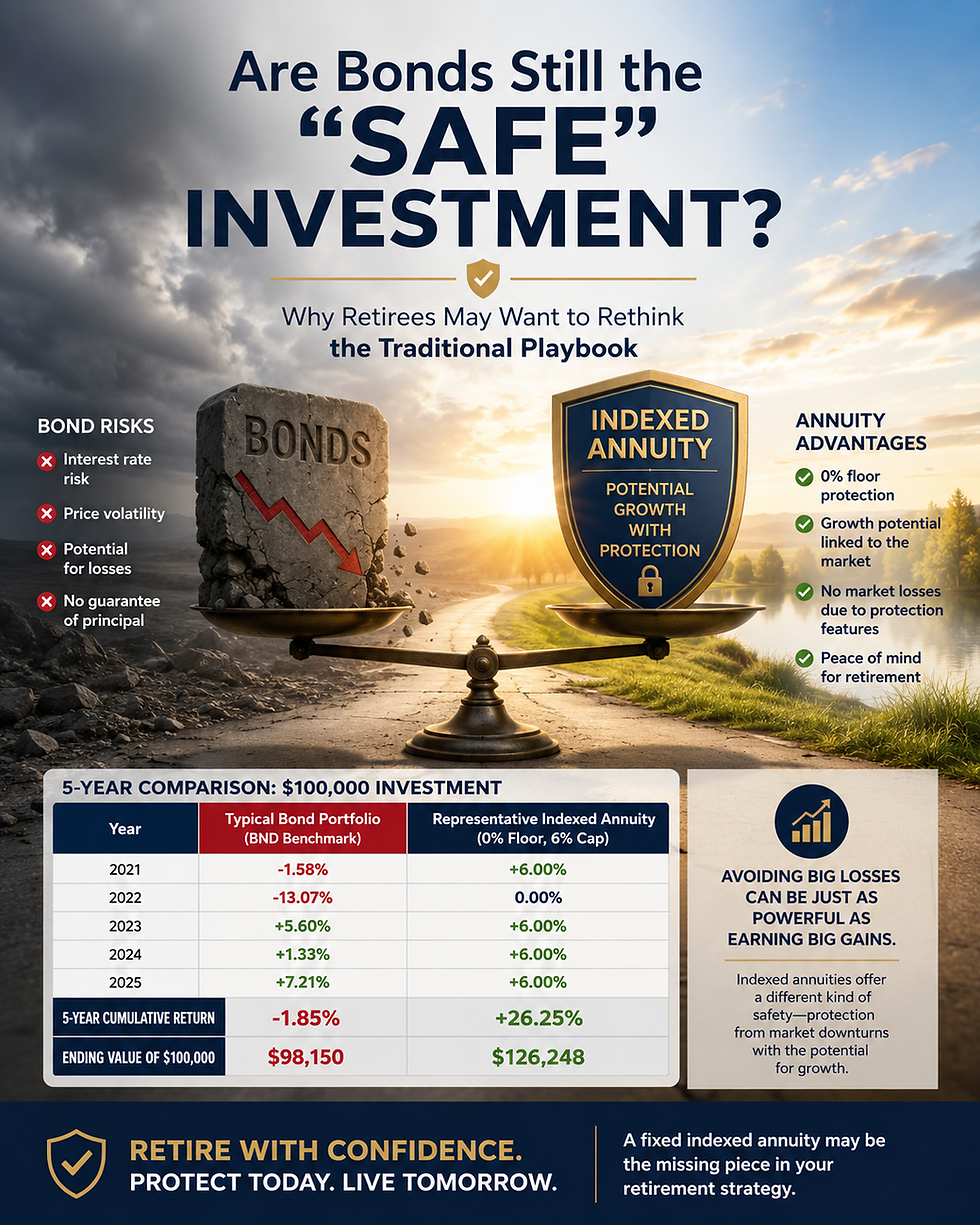
One alternative worth considering is a fixed indexed annuity.
What If the "Safe Money" Had Growth Potential Without Direct Market Losses?
A fixed indexed annuity, or FIA, is an insurance contract.
Instead of directly investing your money in the S&P 500, the insurance company credits interest according to a formula tied to an index.
Depending upon the contract, that might involve a cap, participation rate, spread or other crediting method.
The important distinction is this:
When the market declines, a traditional fixed indexed annuity generally does not credit a negative return because of that market decline.
A 20% stock-market decline does not normally mean your FIA account loses 20%.
You won't receive all of the market's upside either.
That's the tradeoff.
You're giving up some upside potential in exchange for protection from direct market losses.
And today's crediting terms demonstrate why I think this deserves attention.
For example, as of August 2026, Allianz listed an S&P 500 annual point-to-point strategy with a 9% cap on one of its fixed indexed annuities, along with a 4.40% fixed-interest option.
Other current five-year FIA offerings have advertised S&P 500 annual point-to-point caps around 9% to 11% or higher, depending upon the insurance company, product, premium and strategy.
Those are current terms—not guaranteed predictions of future returns—and different products can have dramatically different provisions.
But they raise an interesting planning question.
Let's Change Just One Part of the Portfolio
Suppose we kept the same 60% stock allocation.
But instead of asking 40% of the portfolio to sit in a traditional bond allocation, suppose that money were placed in a hypothetical protected strategy that averaged 4% annually over the five-year period.
This is an illustration, not the historical return of a particular annuity.
Here's what happens.
The stock portion still benefits from the strong market.
But instead of the other 40% growing at roughly 0.08% annually, we're illustrating it growing at 4%.
The approximate result:
Traditional 60/40 illustration:$1,000,000 → $1,502,000
60% S&P 500 / 40% protected 4% illustration:$1,000,000 → $1,587,000
That's approximately:
$85,000 More
And here's what makes that comparison especially interesting.
We didn't increase the stock allocation.
We didn't take the portfolio from 60% stocks to 80% stocks.
We didn't chase technology stocks.
We didn't speculate.
We simply asked:
Could the 40% of the portfolio intended to provide stability have been doing a better job?
This Is the Idea Behind Purpose-Based Retirement Planning
This is exactly why I believe retirement planning should begin with purpose, not products.
Instead of asking every retirement dollar to do everything, we can give different dollars different jobs.
Some money may need to provide income.
Some may need to provide stability and protection.
And some may have enough time to pursue long-term growth.
That's the philosophy behind Purpose-Based Retirement Planning™ powered by Protect. Lock. Grow.™
PROTECT
Protect the dollars you cannot afford to expose to significant market losses.
LOCK
Use strategies designed to preserve gains and provide stability for the money you may need sooner.
GROW
Allow the dollars you won't need for many years to remain invested for long-term growth.
The goal isn't to eliminate the stock market.
It's to potentially give your stock-market investments more time to work.
If another portion of your retirement savings is providing stability, you may be less likely to have to sell stocks after a significant market decline simply because you need income.
That's an entirely different way of thinking about diversification.
Bonds Aren't "Bad"
I want to be clear about that.
Bonds can absolutely have an important role in a portfolio. In fact, with today's higher yields, the outlook for bonds may be considerably different from what investors experienced during much of the last five years. The S&P U.S. Aggregate Bond Index, for example, recently showed a yield to maturity of approximately 4.93%.
And fixed indexed annuities have their own limitations.
They can have surrender charges, liquidity restrictions, caps and participation rates. They generally don't receive stock-market dividends. Crediting terms may change according to the contract. Guarantees depend on the claims-paying ability of the issuing insurance company.
They are not appropriate for everyone.
But neither are bonds.
And that's the point.
Maybe the Problem Isn't Your Portfolio. Maybe It's the Assumption Behind It.
For years, investors have been told:
Stocks for growth. Bonds for safety.
But retirement planning deserves a deeper conversation.
If you're 35 and accumulating money, volatility may simply be part of investing.
If you're 65 and beginning to withdraw money from your portfolio, the consequences can be very different.
You aren't simply trying to earn the highest return.
You're trying to determine:
Which dollars do I need now?
Which dollars need protection?
Which dollars can I leave alone for ten or fifteen years?
Once you answer those questions, you may discover something surprising.
The biggest problem in your retirement account might not be the investments taking too much risk.
It could be the investments taking risk without producing enough return to justify it.
And that is something every retiree should examine.
Want to Know What Each Dollar in Your Retirement Account Is Doing?
If you have a traditional stock-and-bond portfolio, I'd be happy to help you take a closer look.
We'll examine how much of your money is positioned for income, how much is intended to provide stability, how much is pursuing long-term growth—and whether each part is actually doing the job you expect it to do.
That's what I call a Second Financial Opinion.
No obligation. Just an opportunity to look at your retirement strategy from a different perspective.
Learn more about us at: www.j-chris.com
or call:
Christopher Krolak
JChristopher Group
585-490-1969
Purpose-Based Retirement Planning™ Powered by Protect. Lock. Grow.™
This material is for educational purposes only and does not constitute investment, tax or legal advice. Past performance does not guarantee future results. The hypothetical examples above are simplified illustrations and do not represent the performance of an actual portfolio or fixed indexed annuity. Fixed indexed annuities are insurance products and are subject to contract terms, surrender charges, withdrawal limitations, crediting-method provisions and the claims-paying ability of the issuing insurer.
Comments