

Are Bonds Still the “Safe” Investment? Why Retirees May Want to Rethink the Traditional Playbook

For generations, investors approaching retirement were given a familiar piece of advice: reduce your exposure to stocks and move more money into bonds.
The reasoning seemed straightforward. Stocks were for growth. Bonds were for safety.
But the last five years delivered an uncomfortable reminder: bonds can lose money, too—and sometimes a lot of it.
For retirees and pre-retirees who are more concerned with protecting what they have accumulated than chasing maximum market returns, that raises an important question:
Is there a better way to pursue growth while protecting retirement assets from market losses?
One alternative worth considering is a fixed indexed annuity.
The Problem With Calling Bonds “Safe”
Bonds aren't inherently bad investments. They can provide income, diversification and an important role in a well-designed portfolio.
But calling bonds “safe” can create the wrong impression.
When interest rates rise, existing bond prices generally fall. And when rates rose dramatically in 2022, investors discovered just how significant that risk could become.
Consider a broad U.S. bond-market benchmark. Vanguard's Total Bond Market ETF (BND), which tracks the broad investment-grade U.S. bond market, reported benchmark returns of approximately:
Year | Broad Bond Benchmark |
2021 | -1.58% |
2022 | -13.07% |
2023 | +5.60% |
2024 | +1.33% |
2025 | +7.21% |
Source: Vanguard.
The number that jumps off the page is 2022: -13.07%.
For someone 20 or 30 years from retirement, a temporary decline may be manageable. But for someone preparing to retire—or already withdrawing money from a portfolio—a double-digit loss in an asset class they believed was their “safe money” can be a very different experience.
And despite the recovery that followed, compounding those five annual benchmark returns means $100,000 would have ended 2025 at only about $98,150.
In other words, across this particular five-year period, the broad bond benchmark's cumulative return was approximately -1.85%, despite its strong rebound in 2025.
That doesn't mean bonds no longer belong in a portfolio. In fact, today's higher yields have improved their forward-looking appeal. As of mid-2026, Vanguard's broad bond benchmark showed a five-year average annual return near zero, while current bond yields had become considerably more attractive.
What it does mean is that investors should understand the difference between lower risk and no risk.
Now Consider a Fixed Indexed Annuity
A fixed indexed annuity, or FIA, approaches risk differently.
Rather than directly investing your money in the stock market, the insurance company credits interest based in part on the performance of an external index, subject to the terms of the contract.
A traditional FIA may offer a 0% floor on an indexed crediting strategy. If the index falls during the applicable crediting period, the indexed interest credit may be zero rather than negative.
That's a fundamentally different experience from watching a bond portfolio decline 10% or 15%.
The tradeoff is that you generally don't receive all of the market's upside. Indexed annuities use features such as caps, participation rates and spreads to determine how much interest gets credited. Dividends from an equity index also generally aren't included.
So let's look at a simple illustration.
A Five-Year Comparison: Bonds vs. a Representative Indexed Annuity
Suppose an investor placed $100,000 into two different strategies at the beginning of 2021.
The first tracks the broad U.S. investment-grade bond market.
For the second, we'll use a hypothetical fixed indexed annuity tied to the S&P 500 price index with:
Annual point-to-point crediting
A 0% floor
A hypothetical 6% annual cap
No withdrawals during the five-year period
This isn't the performance of a particular annuity and isn't a quote for a currently available product. Actual FIA caps, participation rates, spreads, guarantees and renewal rates vary by insurer and contract and can change over time. The example simply demonstrates how the mechanics of an indexed strategy could have behaved.
Under this hypothetical structure, a year in which the index gained more than 6% would receive a 6% credit. A negative index year would receive a 0% indexed interest credit.
Using the 2021–2025 market environment for illustration, the comparison looks roughly like this:
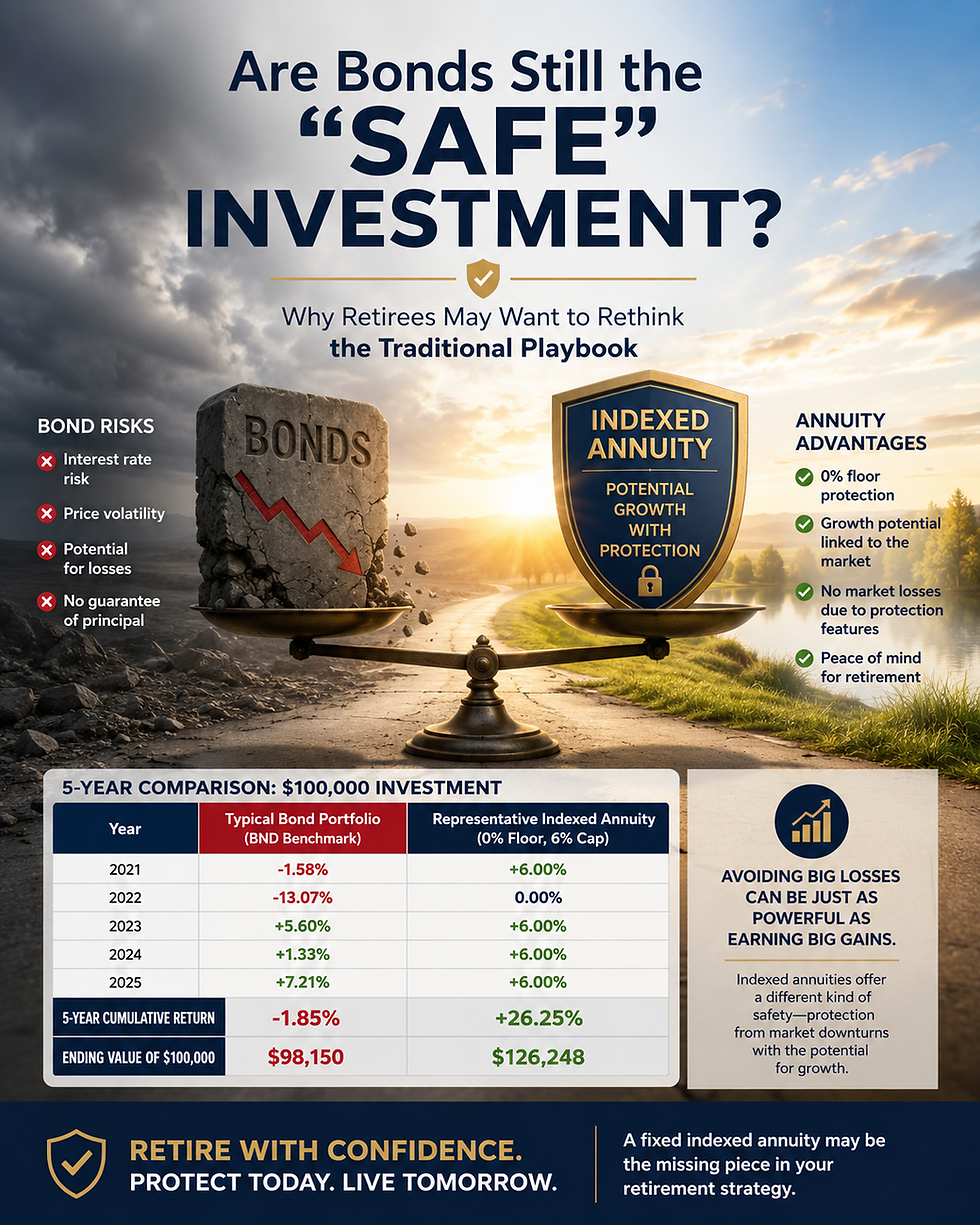
Year | Broad Bond Benchmark | Hypothetical FIA Credit* |
2021 | -1.58% | +6.00% |
2022 | -13.07% | 0.00% |
2023 | +5.60% | +6.00% |
2024 | +1.33% | +6.00% |
2025 | +7.21% | +6.00% |
Approx. 5-Year Cumulative Return | -1.85% | +26.25% |
Approx. Ending Value of $100,000 | $98,150 | $126,248 |
*Hypothetical illustration assuming the S&P 500 price index produced gains exceeding the hypothetical 6% cap in 2021, 2023, 2024 and 2025 and a negative return in 2022. It does not represent an actual annuity's historical performance. The S&P 500 is an unmanaged index and cannot be invested in directly.
The hypothetical annuity's annualized return would be approximately 4.77% over the period, compared with approximately -0.37% annually for the broad bond benchmark.
But the most interesting part of the comparison isn't simply the ending balance.
It's how the investor got there.
The Power of Avoiding the Big Loss
Look again at 2022.
The bond benchmark lost approximately 13%. The hypothetical FIA earned 0%.
Zero doesn't sound exciting—until the alternative is losing 13%.
This illustrates one of the most important mathematical realities of retirement investing: avoiding a large loss can be just as important as capturing a large gain.
If an investment falls 20%, it needs a 25% gain just to get back to where it started.
An FIA's appeal isn't that it will outperform the stock market. In strong bull markets, it often won't. The cap or participation rate deliberately gives up part of the upside.
Instead, the value proposition is different:
Give up some of the upside in exchange for protection against market-index losses under the contract's terms.
For an investor approaching retirement, that tradeoff may be compelling.
Bonds and Annuities Don't Provide the Same Kind of “Safety”
This distinction matters.
A bond fund's value fluctuates with interest rates, credit conditions and the securities in its portfolio. Higher rates can push existing bond prices lower, as investors experienced dramatically in 2022.
A fixed indexed annuity transfers certain market risks to an insurance company. The investor accepts limitations on liquidity and upside potential in exchange for contractual guarantees.
That means an FIA introduces a different set of considerations.
Annuities are insurance products, and their guarantees depend on the claims-paying ability of the issuing insurance company. They are not FDIC- or SIPC-insured. Contracts can also include surrender periods and charges that make them inappropriate for money an investor may need to access in the near term.
Those tradeoffs need to be evaluated carefully.
The Retirement Question Has Changed
For years, the traditional retirement conversation was largely about asset allocation:
How much should I have in stocks versus bonds?
Perhaps a better conversation is:
What job does each dollar in my retirement portfolio need to perform?
Some money may need long-term stock-market growth.
Some may need to remain liquid for emergencies and near-term expenses.
And some may have a different job entirely:
Protect principal from market downturns while still creating an opportunity for interest credits.
That's where a fixed indexed annuity can become an interesting alternative for the conservative portion of a retirement strategy.
It's Not “Bonds or Annuities”
The lesson from the past five years isn't that investors should abandon bonds.
Bonds still offer diversification, liquidity and income, and today's higher yields may make them more attractive than they were several years ago. In fact, recent evidence continues to support a role for bonds in diversified portfolios.
The lesson is that investors shouldn't automatically equate bonds with guaranteed safety.
The 2022 bond-market decline shattered that assumption for many investors.
A fixed indexed annuity provides a different proposition: accepting limits on upside and liquidity in exchange for contractual protection from certain market losses.
For someone approaching retirement, that can be a powerful trade.
Maybe “Safe Money” Needs a New Definition
Retirement planning isn't simply about earning the highest return.
It's about creating a strategy that allows you to stay retired.
That means considering growth, income, liquidity, taxes, longevity—and protection against losses at precisely the wrong time.
Over the 2021–2025 period, a broad bond-market benchmark experienced a historic decline and finished the five-year period roughly flat. A hypothetical indexed-annuity strategy with a 0% floor and 6% cap would have produced a very different experience.
Past performance doesn't tell us what happens next, and no hypothetical illustration can predict the return of an actual annuity.
But the comparison makes one point very clear:
If the goal of a portion of your retirement portfolio is safety, it may be time to look beyond the traditional definition of “safe.”
A fixed indexed annuity may deserve a place in that conversation.
Is Your “Safe Money” Really Safe?
If you're approaching retirement, now may be the right time to take a closer look at the portion of your portfolio you've traditionally considered “safe.”
Schedule a complimentary retirement review today to see how your current bond allocation compares with today's fixed indexed annuity options—and whether adding principal protection and growth potential could strengthen your retirement strategy.
Protect what you've built. Create a strategy for what comes next.
Contact us today to start the conversation.
Christopher Krolak
📞 585-490-1969
Important disclosure: This material is for educational purposes only and is not a recommendation to purchase or sell any investment or insurance product. The indexed-annuity example is hypothetical and does not represent an actual product or actual contract performance. Indexed annuities vary materially in caps, participation rates, spreads, crediting methods, surrender periods, fees and other provisions. Contract values and guarantees are subject to the claims-paying ability of the issuing insurer. Withdrawals may be subject to surrender charges, market-value adjustments where applicable, income taxes and, for certain distributions before age 59½, a federal tax penalty. Investors should review the specific contract and consult appropriate financial and tax professionals before making a decision.


Comments