

Do You Own Structured Notes in Your Portfolio? Make Sure You Understand the Risks

Structured notes have become an increasingly visible part of the investment landscape.
They are often marketed as a way to generate attractive income, participate in market gains, or provide some protection against losses.
Those features can sound compelling—especially when investors want higher income without taking what appears to be the full risk of the stock market.
But structured notes can also be far more complicated than they first appear.
And history provides an important reminder: even a structured note whose underlying investment performs as expected can run into serious trouble if the financial institution that issued the note fails.
If you own structured notes—or are considering purchasing one—it is important to understand exactly what you own, how your return is calculated, and what could happen when markets or the issuer move against you.
What Is a Structured Note?
A structured note is generally a debt obligation issued by a financial institution whose return is linked to the performance of another asset or benchmark.
That benchmark might be:
The S&P 500 or another stock index
An individual stock
A basket of stocks
Interest rates
Commodities
Currencies
Other market indexes or assets
Unlike a traditional bond, where an investor typically receives a stated interest rate and the return of principal at maturity, the payoff from a structured note can depend on a formula tied to the underlying investment.
And that formula matters.
Two notes linked to the same stock market index can produce dramatically different outcomes depending on their terms.
The Appeal of Structured Notes
Structured notes can be designed to address specific investment objectives.
For example, a note might offer an attractive annual coupon as long as a particular stock index does not fall below a specified level. Another might allow an investor to participate in stock-market gains while providing a limited buffer against losses.
On the surface, arrangements like these can appear to offer the best of both worlds.
But there is usually a tradeoff.
Higher income may come with substantial downside risk. Principal protection may be conditional rather than guaranteed. Upside participation may be capped. And the protections investors expect may disappear once certain thresholds are crossed.
Understanding those tradeoffs is essential.
Six Risks Structured Note Investors Should Understand
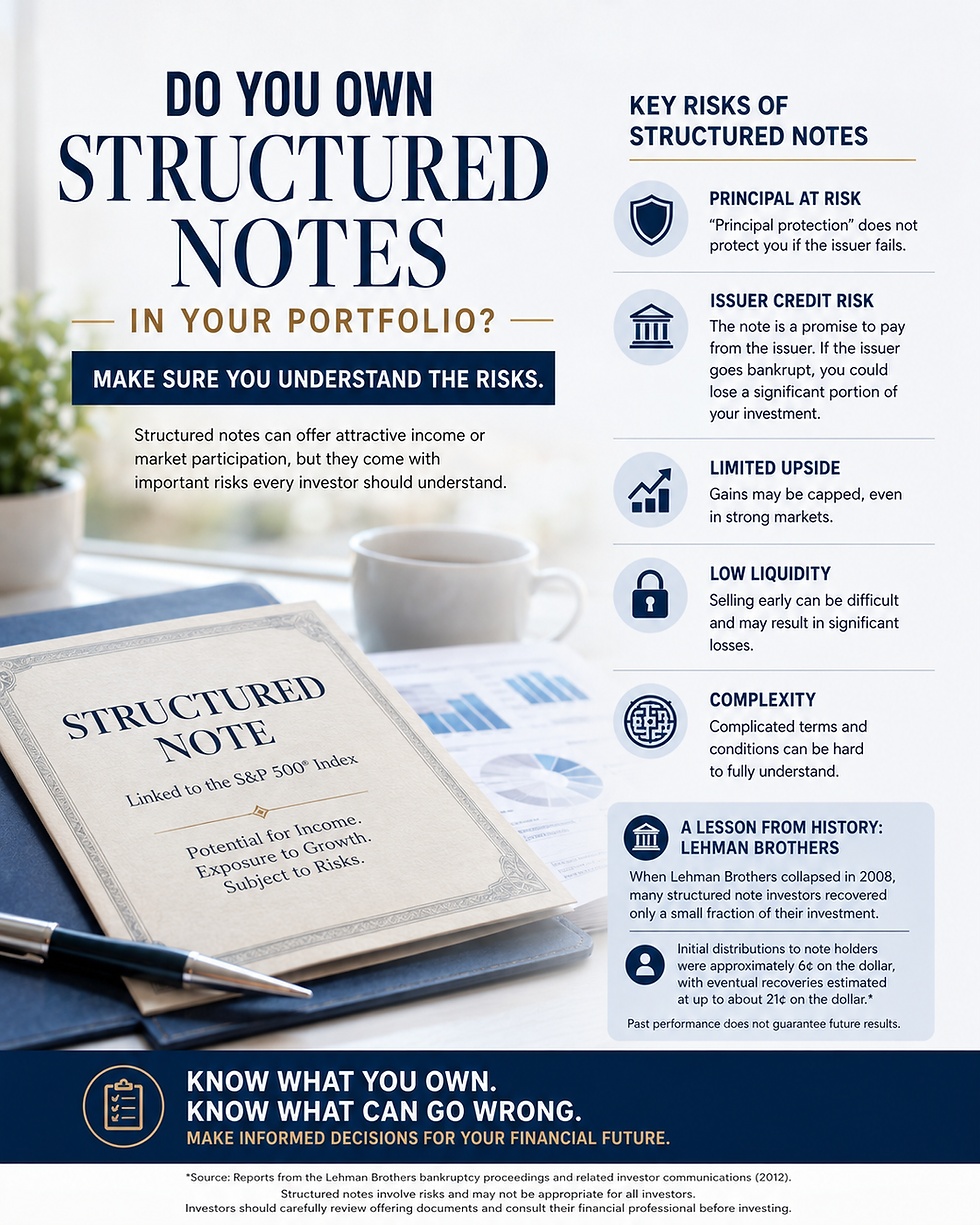
1. Your Principal May Be at Risk
The word "note" can make an investment sound similar to a conventional bond. But many structured notes do not guarantee the return of your full principal.
Consider a hypothetical note linked to a stock index with a 20% downside buffer.
An investor might assume that means the first 20% of losses are absorbed by the note. Depending on the structure, that may be true.
But another note may simply have a 20% barrier. If the index falls through that barrier, the investor could suddenly become exposed to much more of the underlying decline.
Those are very different risk profiles.
Investors should understand whether their note contains a buffer, barrier, trigger, floor, or some other form of conditional protection—and exactly what happens if that level is breached.
2. Attractive Income Usually Comes With a Cost
A structured note offering a high coupon may look particularly attractive compared with CDs, Treasury securities, or traditional bonds.
But the higher yield generally exists because the investor is accepting additional risk.
When evaluating the yield, don't simply ask:
"How much does this pay?"
Also ask:
"What risk am I taking in exchange for that payment?"
3. Your Upside May Be Limited
Some structured notes offer exposure to market appreciation—but only up to a certain point.
Suppose a note linked to the S&P 500 has a maximum return of 12%. If the index rises 25% during the note's term, the investor may still receive only the 12% maximum return.
That means investors can potentially accept significant downside exposure without receiving all of the upside they would have earned by owning the underlying investment directly.
4. Structured Notes Carry Issuer Credit Risk—and Lehman Brothers Showed How Severe That Risk Can Be
This is one of the most important lessons investors can learn about structured notes.
A structured note is ultimately a promise to pay made by the financial institution that issues it. FINRA emphasizes that even a note offering 100% principal protection can result in the loss of the investment if the issuer becomes unable to meet its obligations or goes bankrupt.
That isn't merely a hypothetical risk.
Consider what happened when Lehman Brothers collapsed in September 2008.
Prior to its bankruptcy, Lehman had issued structured notes to investors, including products marketed with principal-protection features. When Lehman failed, the protection built into those products could not protect investors against the failure of Lehman itself. The SEC subsequently highlighted Lehman as an example of how investors in principal-protected structured notes can become unsecured creditors when the issuer goes bankrupt.
What Did Lehman Structured-Note Investors Actually Lose?
The numbers help put the risk into perspective.
According to a 2012 report from an investor law firm representing Lehman note holders, the initial bankruptcy distribution to Lehman note holders was approximately 6 cents for every dollar invested. At the time, the firm reported that note holders might ultimately receive as much as approximately 21 cents on the dollar as the bankruptcy liquidation continued.
Think about what that means for an investor.
If someone had invested $100,000 in one of these Lehman notes, a recovery of 21 cents on the dollar would equate to approximately $21,000 recovered—an approximately $79,000 loss, before considering any other payments, settlements, taxes, or individual circumstances.
On a $500,000 investment, the same recovery rate would mean approximately $105,000 recovered and $395,000 not recovered through that assumed recovery.
And on $1 million, it would mean approximately $210,000 recovered versus approximately $790,000 not recovered.
Those examples are illustrations based on the reported 21-cent recovery estimate; actual recoveries for particular investors could differ depending on the security, claim, subsequent distributions, settlements, and other circumstances.
More broadly, research from the Federal Reserve Bank of New York found that Lehman's creditors ultimately had a recovery rate of approximately 28%, illustrating the severity of losses across the Lehman bankruptcy.
The lesson for today's investor is extremely important:
"Principal protected" does not necessarily mean your money is protected against the failure of the company making the promise.
If a structured note says you receive 100% of your principal at maturity, that promise is only as strong as the issuer standing behind it. FINRA specifically warns that if the issuer goes bankrupt, structured-note investors are typically unsecured creditors and may recover little, if any, of their original investment.
Lehman turned that warning into reality.
An investor could have selected a perfectly reasonable underlying index and purchased a product promising principal protection—and still suffered a devastating loss because the institution responsible for making the payment failed.
That is why evaluating a structured note should involve two separate questions:
1. What happens if the underlying investment performs poorly?
And just as importantly:
2. What happens to my money if the issuer fails?
5. Getting Out Early May Be Difficult or Expensive
Structured notes are generally designed to be held until maturity.
Although an issuer or broker may provide a secondary market, liquidity can be limited. The price offered before maturity may also be substantially below the amount originally invested.
The value of a note before maturity can be influenced by changes in the underlying investment, interest rates, market volatility, time remaining until maturity, the issuer's creditworthiness, and market liquidity.
6. Complexity Itself Is a Risk
Perhaps the most important risk is also the easiest to underestimate.
Terms such as autocall, contingent coupon, knock-in barrier, participation rate, buffer, and observation date can materially change an investment's outcome.
A useful test is simple:
Can you explain what causes the investment to make money, lose money, stop paying income, or mature early?
If not, you may not fully understand the investment.
Are There Alternatives to Structured Notes?
For investors primarily interested in principal protection combined with some potential to benefit from market gains, structured notes aren't the only option worth considering.
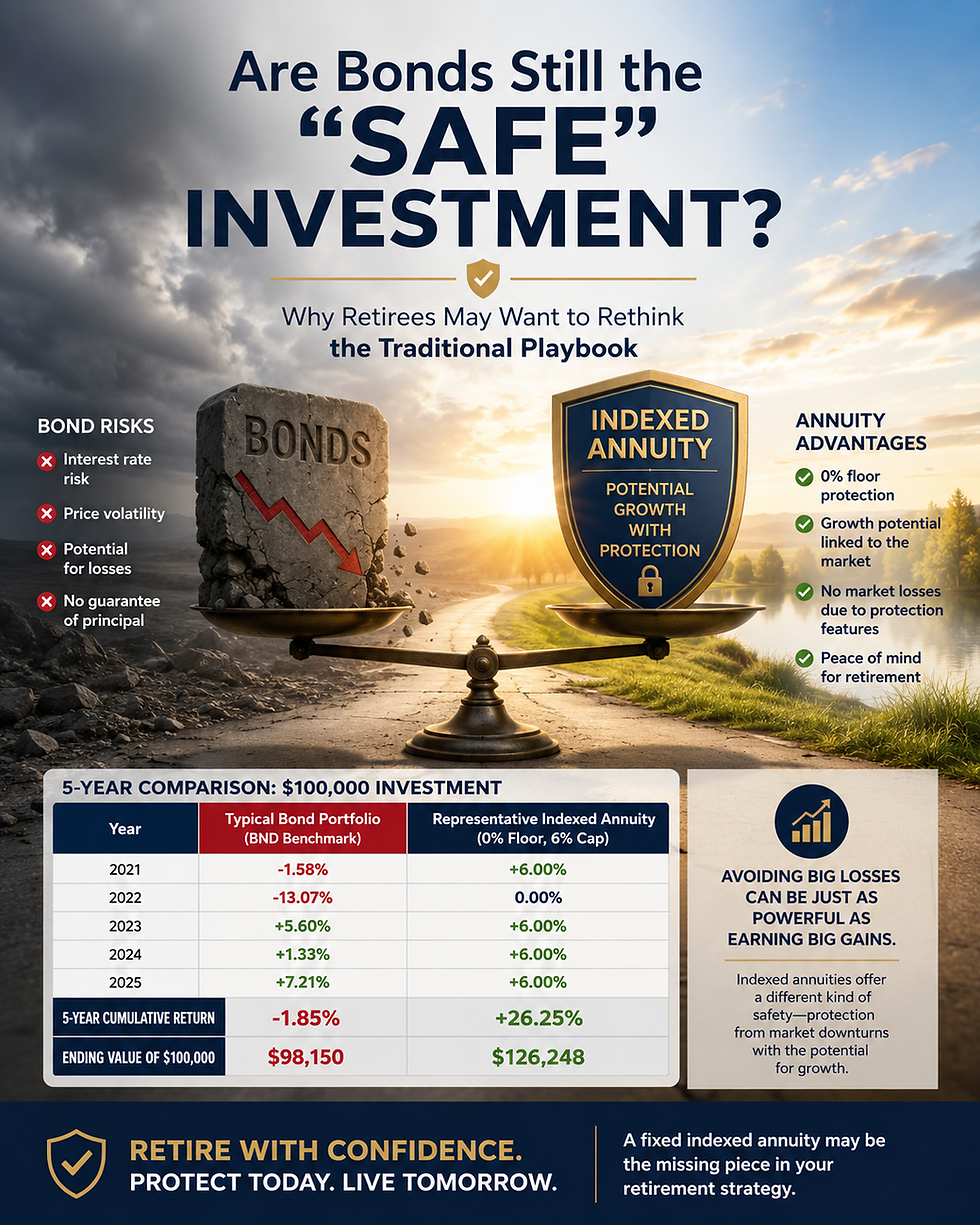
One potential alternative is a fixed indexed annuity (FIA).
A fixed indexed annuity is an insurance contract rather than an unsecured note issued by an investment bank. Interest credited to the contract can be linked to the performance of an external market index, subject to the terms of the contract.
This creates an important difference in how risk is structured.
The contractual guarantees of a fixed indexed annuity are backed by the claims-paying ability and financial strength of the issuing insurance company. Annuities are insurance products regulated primarily at the state level.
In addition, eligible annuity obligations may receive protection from a state insurance guaranty association if an insurer becomes insolvent, subject to state-specific eligibility requirements and coverage limits.
That protection should not be confused with FDIC insurance, nor should it be described as an unlimited guarantee from a state government. But it represents a layer of protection that structured notes generally do not have.
The Lehman experience makes that distinction particularly relevant.
A structured-note investor is exposed to the creditworthiness of the issuing financial institution. If that institution fails, the investor may become an unsecured creditor—as Lehman investors discovered.
A fixed indexed annuity owner also assumes issuer risk, so selecting a financially strong insurance company remains important. However, eligible annuity obligations may also fall within the applicable state's guaranty association framework if the insurer becomes insolvent.
That doesn't automatically make a fixed indexed annuity superior to a structured note.
Fixed indexed annuities have their own tradeoffs, including surrender periods, withdrawal restrictions, caps, participation rates, spreads, liquidity limitations, tax considerations, and the financial strength of the issuing insurer.
But if the primary goal is protecting principal while maintaining some opportunity for index-linked interest, it may make sense to compare the two approaches rather than assuming a structured note is the only solution.
Don't Evaluate a Structured Note in Isolation
Another common mistake is analyzing a structured note solely on its individual merits.
The more important question may be:
What role does this investment play in your overall portfolio?
An investor could own several different structured notes and believe the portfolio is diversified because the notes have different maturity dates, coupons, or issuers.
But if all of those notes are ultimately linked to the stock market, the portfolio may contain considerably more equity exposure than the investor realizes.
Questions to Ask If You Own a Structured Note
Before purchasing a structured note—or when reviewing one you already own—make sure you can answer these questions:
What is the note linked to?
When does it mature?
Is my principal guaranteed, buffered, or fully at risk?
What happens if the underlying investment falls 10%, 20%, 30%, or 50%?
Is there a barrier or trigger level?
Is my potential return capped?
Are coupon payments guaranteed or conditional?
Can the issuer redeem the note early?
What happens if I need to sell before maturity?
Who issued the note, and what credit risk am I taking?
What happens to my investment if the issuer goes bankrupt?
What fees or embedded costs are associated with the investment?
Are there alternative strategies that could accomplish a similar objective with a different risk profile?
How does this exposure fit with the rest of my portfolio?
The Bottom Line
Structured notes are not inherently good or bad investments. In the right circumstances, a carefully selected structured note may serve a specific purpose within a diversified portfolio.
But the collapse of Lehman Brothers provides a powerful warning about a risk investors can easily overlook.
Some investors owned structured notes that appeared to offer substantial or even full principal protection. Yet after Lehman failed, reports indicated that note holders initially received only about 6 cents on the dollar, with an eventual recovery at that time estimated at up to roughly 21 cents on the dollar.
That's the difference between protection provided by an investment formula and protection from the failure of the company standing behind that formula.
Investors seeking downside protection should also recognize that structured notes aren't the only option. Depending on an investor's objectives, fixed indexed annuities and other strategies may offer different combinations of growth potential, contractual guarantees, liquidity, and protection.
Every strategy has tradeoffs.
Know what you own. Know who owes you the money. Know what happens if that company fails. And make sure the risks you're taking are consistent with the financial plan you're trying to achieve.
Do You Know What You Own?
If structured notes are part of your portfolio, now may be a good time to take a closer look.
Understanding the potential return is only half the equation. You should also know how much principal is truly at risk, what happens if a barrier is breached, how liquid the investment is, and what could happen if the issuing institution runs into financial trouble.
I can help you review the structured notes you currently own, explain the risks in plain English, and evaluate whether they still make sense within your overall retirement and financial strategy.
Have structured notes in your portfolio? Let's take a closer look.
Contact Christopher Krolak today to schedule a complimentary, no-obligation portfolio review and get a clearer understanding of what you own, how it works, and the risks you may be taking.
Christopher Krolak
Call: 585-490-1969
Know what you own. Understand the risks. Make informed decisions about your financial future.
This material is for informational and educational purposes only and should not be considered individualized investment, insurance, tax, or legal advice. Structured notes and annuities involve different risks, costs, liquidity provisions, tax considerations, and guarantees. Annuity guarantees are subject to the claims-paying ability of the issuing insurer. State guaranty association coverage is subject to eligibility requirements and state-specific limits and is not the same as FDIC insurance or a direct guarantee by a state government. Historical examples do not necessarily reflect the results an investor would experience today. Investors should carefully review applicable offering or contract documents and consult appropriate financial, tax, and legal professionals before making investment decisions.


Comments