

With Markets Near Record Highs, Why More Pre-Retirees and Retirees Are Reducing Risk Without Giving Up the Opportunity for Growth


A Case Study on Reducing Risk Without Giving Up the Opportunity for Growth
For many people approaching retirement, the biggest financial challenge isn't simply growing their money—it's protecting what they've already spent decades building.
After years of accumulating retirement savings, the conversation naturally shifts from "How much can I make?" to "How much can I afford to lose?"
Unfortunately, many investors unknowingly remain exposed to the same level of stock market risk they had in their 40s and 50s, even though they are only a few years away from relying on those assets for income.
This is where de-risking the equity sleeve of a retirement portfolio can make a meaningful difference.
Understanding the Challenge
Imagine a client who has accumulated a substantial retirement portfolio and plans to retire within the next five years.
They understand that inflation remains a concern and they want their investments to continue growing. However, they're also worried about what would happen if the market experienced another major decline just as they retire.
This creates a difficult balancing act.
They need:
Growth that has the potential to outpace inflation
Protection from significant market losses
Confidence that a bear market won't derail their retirement income plan
Unfortunately, traditional portfolio construction often forces investors to choose between two imperfect options:
Option 1: Stay Heavily Invested in Stocks
Pros:
Higher long-term growth potential
Opportunity to outperform inflation
Cons:
Significant downside risk
Potentially devastating losses just before or during retirement
Greater exposure to sequence-of-returns risk
Option 2: Move More Assets Into Bonds
Pros:
Reduced volatility
More predictable income
Cons:
Lower expected returns
Interest-rate risk
Inflation may gradually erode purchasing power
Today's bond yields may not provide enough long-term growth
Neither solution is ideal for many retirees.
What Is Sequence-of-Returns Risk?
One of the greatest threats facing retirees isn't simply market volatility.
It's when that volatility occurs.
A large market decline early in retirement can permanently damage a portfolio because withdrawals continue while account values are falling.
Those shares sold during a downturn are no longer available to participate in the eventual recovery.
Two retirees may average the exact same long-term market return, yet the person who experiences losses during the first few years of retirement may end up with dramatically less money later in life.
That's sequence-of-returns risk.
It is often one of the most overlooked risks in retirement planning.
A Different Approach: De-Risking the Equity Sleeve
Rather than eliminating growth altogether, many retirees choose to reduce risk by reallocating a portion of their equity exposure into investments designed to provide:
Principal protection
Market-linked growth opportunities
Reduced volatility
Tax-deferred growth (where applicable)
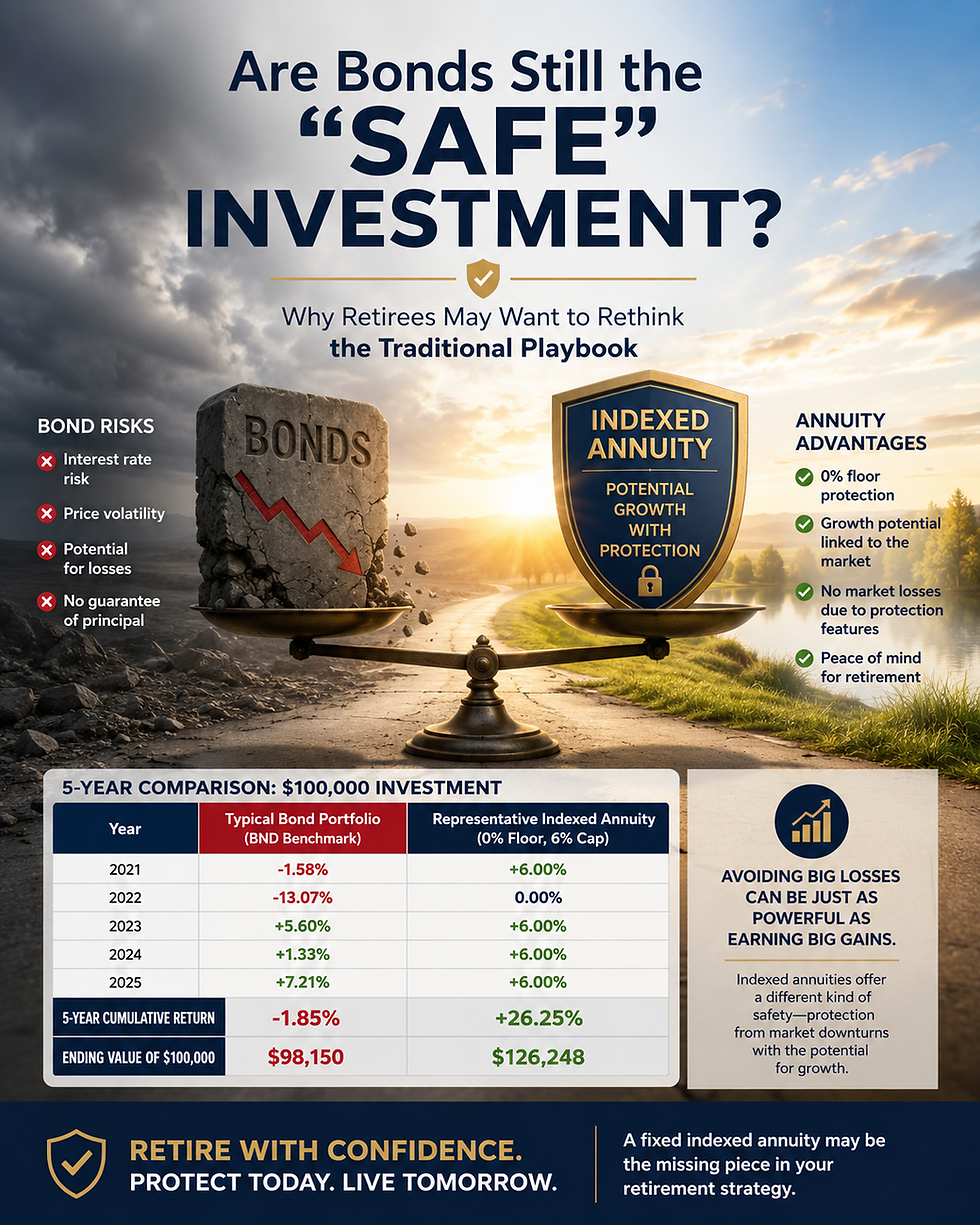
One example is a fixed indexed annuity (FIA).
Unlike traditional market investments, a fixed indexed annuity does not directly participate in stock market gains or losses.
Instead, interest is credited based on the performance of a market index, subject to the terms of the contract.
While returns may be limited by caps, participation rates, or spreads, the contract generally provides protection against direct market losses to the account value.
This means:
Positive index performance may result in interest being credited.
Negative index performance generally does not reduce the contract value because of market declines.
As with any financial product, terms vary by issuer and contract.
The Case Study
Meet Susan
Susan is 62 years old and plans to retire in three years.
She has accumulated:
$900,000 in retirement assets
70% invested in equities
30% invested in bonds
Although she's pleased with her long-term investment performance, she's increasingly concerned that a significant market correction could delay her retirement.
Instead of moving everything into conservative investments, Susan works with her financial professional to redesign her portfolio.
The updated strategy:
A portion of her equity allocation remains invested for long-term growth.
A portion is repositioned into a fixed indexed annuity designed to provide principal protection while offering the opportunity for market-linked interest credits.
Cash reserves are maintained for near-term income needs.
Income planning is coordinated with Social Security and other retirement resources.
The result is a portfolio designed to better balance growth potential with downside protection.
Susan understands she may not capture every bit of a strong bull market, but she also gains greater confidence knowing that a severe market downturn may have less impact on the assets intended to support her retirement.
Why Many Pre-Retirees Are Making This Shift
For many investors nearing retirement, the objective changes.
Instead of trying to maximize returns, they begin asking:
How can I reduce unnecessary risk?
How much market exposure do I really need?
Can I protect part of my retirement without giving up all growth opportunities?
What happens if the market falls the year I retire?
These are important planning questions.
The answers are different for every investor, but they deserve careful consideration before retirement begins.
The Goal Isn't to Eliminate Risk
No investment strategy removes every type of risk.
Inflation, longevity, taxes, healthcare expenses, and unexpected life events will always remain part of retirement planning.
The objective isn't to eliminate risk.
It's to manage the risks that matter most.
For many retirees, that includes protecting a portion of their retirement savings from major market declines while maintaining the opportunity for continued growth.
A thoughtfully diversified retirement strategy may provide greater confidence during uncertain markets and help support a more predictable retirement income plan.
Is It Time to Review Your Equity Exposure?
If you're within ten years of retirement—or already retired—it may be worth asking whether your portfolio is aligned with your current goals rather than the goals you had decades ago.
A second opinion can help you evaluate:
Whether you're taking more market risk than necessary
How sequence-of-returns risk could affect your retirement income
Ways to potentially reduce investment volatility while maintaining growth opportunities
Whether products such as fixed indexed annuities are appropriate for your overall financial strategy
Sometimes, retirement isn't about chasing higher returns.
It's about creating a portfolio designed to help you retire with greater confidence.
Complimentary Retirement Risk Review
If you're wondering whether your current portfolio is appropriately positioned for retirement, we'd be happy to help.
At JChristopher Group, we specialize in helping individuals and families evaluate retirement risk, identify opportunities to reduce unnecessary market exposure, and build income strategies designed to support long-term financial confidence.
Call 585-490-1969 to schedule your complimentary Retirement Risk Review.
Important Disclosure
This article is for educational purposes only and should not be considered investment, tax, or legal advice. All investments involve risk, including the possible loss of principal. Fixed indexed annuities are insurance products issued by insurance companies and are subject to the claims-paying ability of the issuing insurer. They are not directly invested in the stock market. Interest-crediting methods, caps, spreads, participation rates, surrender charges, and other contract provisions vary by product. Guarantees are based on the financial strength and claims-paying ability of the issuing insurance company. Consult your financial, tax, and legal professionals before making investment decisions.

Comments